

Successful international cooperation is not driven by shared goals and professional expertise alone. In German–Chinese cooperation, differences in ways of thinking and working often determine whether projects move forward or stall. Many conflicts are not the result of individual mistakes, but of deeper structural and cultural differences that shape everyday collaboration.
This article is based on a talk I have given several times. Truly understanding how Chinese partners think and work – and how this differs from German approaches – requires far more than a single article or presentation. What this piece can offer is awareness: for a topic that is frequently underestimated and often only becomes visible once problems have already emerged.
If you would like to explore this topic in greater depth or clarify specific questions or situations, please do not hesitate to contact me.
Why German–Chinese Cooperation Often Stalls
A familiar scenario in German–Chinese business cooperation: a project plan has been finalized, a contract has been signed, and the project is ready to start. From a German perspective, the major coordination work is complete and implementation can begin according to plan. From a Chinese perspective, this moment represents just another step in an ongoing alignment process. Project plans and contracts are seen as adaptable frameworks, open to adjustment as circumstances evolve. Negotiation, in this sense, is never fully concluded.
This is often where frustration first arises.
“Why doesn’t the Chinese side stick to what was agreed?”
“Why is the German side so inflexible?”
These are questions I have heard repeatedly in German–Chinese projects. They point to a broader pattern: friction caused by different assumptions about planning, commitment, and change. Such misunderstandings can arise at every stage of cooperation. They often remain invisible for a long time because they are rooted in cultural assumptions that feel self-evident to those involved.
International cooperation makes these implicit assumptions visible. Established ways of working, communicating, and making decisions suddenly no longer apply or are interpreted very differently. To deal with this constructively, a basic understanding of culture is essential.
Cultural Imprints as an Invisible Factor
Culture emerges through social interaction. Shared values, norms, and ways of thinking shape group behavior and are passed on over generations. They differ across societies, social groups, and organizations and they are constantly evolving.
Culture works mostly beneath the surface. It influences what is considered “normal,” how decisions are made, and how communication is understood. Cultural researcher Geert Hofstede describes culture as the ‘software of the mind’, as a collective imprint on thinking and behaviour.
Cultural patterns can provide orientation, especially in German–Chinese cooperation. At the same time, they should never obscure individual differences. People are shaped not only by culture, but also by context, biography, and organizational environment.
Among other things, China is influenced by Confucianism, Taoism and Buddhism, as well as by socialism with Chinese characteristics. These influences still inform many taken-for-granted assumptions today. In Germany, other historical influences dominate, including Christianity, Enlightenment thinking, Prussian bureaucratic efficiency, and democratic principles. These foundations are reflected in language, art, relationship-building, and work organization.
Culture is not static. It changes continuously as societies evolve. This is why there can be no simple manual for how “Germans” or “Chinese” work. Still, understanding core patterns of thinking and working helps make sense of intercultural collaboration.
Key Ways of Thinking and Working in the Chinese Context
Two aspects are particularly relevant in many German–Chinese business relationships.
Guanxi, Mianzi, Renqing, and Harmony
Several concepts rooted in Chinese philosophy continue to shape cooperation in China, often implicitly.
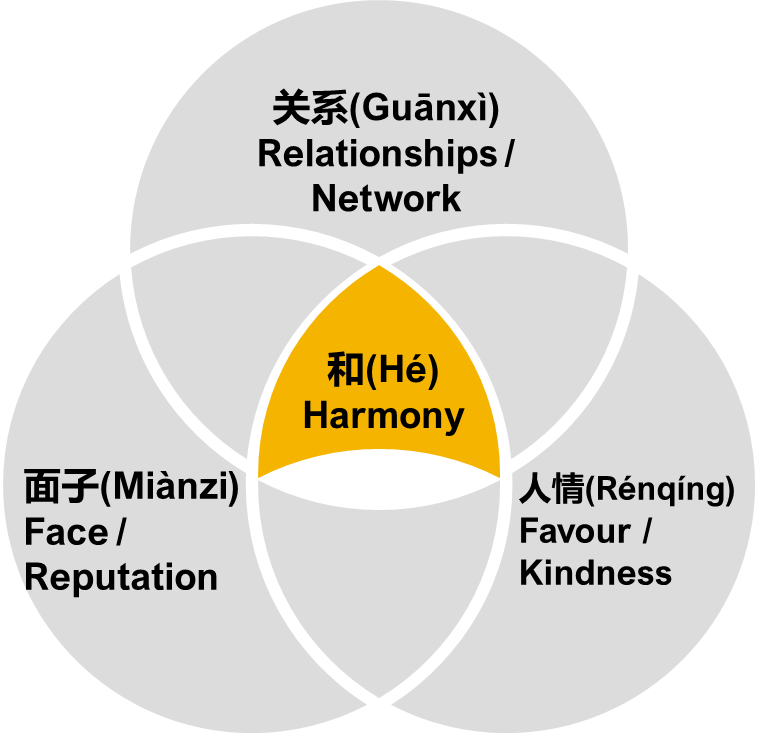
Guanxi refers to networks of relationships based on long-term trust and mutual support. It is not simply about knowing people, but about building reliable, enduring connections.
Closely linked to this is Mianzi, or “face,” which relates to reputation, dignity, and social standing. Preserving face means showing respect and avoiding public embarrassment.
Renqing describes the principle of reciprocity. Favors create obligations that are expected to be balanced over time.
When these elements interact successfully, they create harmony. Harmony is widely seen as a desirable state because it stabilizes relationships and makes cooperation smoother and more sustainable.
“Crossing the River by Feeling the Stones”

The Chinese expression 摸着石头过河 (mōzhe shítou guò hé) became widely known when Deng Xiaoping used it to describe China’s reform and opening-up policy. The phrase is still often quoted by the Chinese leadership today to describe how reforms are implemented. It refers to an approach where goals are roughly defined, while the path toward them is developed step by step through experimentation.
This principle shapes not only political reforms, but also business practices. It reflects an open, exploratory way of working with a high tolerance for ambiguity.
Essentially, the phrase describes what innovative software developers later called ‘agile project management’ and made socially acceptable worldwide. While training courses and regulations are often necessary for this in Germany, the iterative approach is taken for granted in China and is often implemented pragmatically and without formal methodology.
Conversely, highly structured, long-term project plans can be challenging in Chinese contexts because they leave little room for adaptation.
When Working Styles Collide: A Practical Example
What happens when these different ways of thinking and working meet in practice?
Consider the following case, which reflects many experiences from German–Chinese cooperation.
Of course, many examples look very different in reality. Cultural influences are neither universal nor static, and every collaboration is unique. Nevertheless, there are certain constellations that I encounter time and again in German-Chinese cooperation.
The case: A German company aims to develop a new product in China. The specific product is not important here. Development takes place at a Chinese production site, together with local product developers.
On the German side, there is a detailed project plan, a clear quality management system, and extensive pre-testing. Parameters are carefully calculated and validated to minimize errors and achieve a near-perfect final product.
The Chinese team reviews the plan and begins experimenting. Individual parameters are adjusted to see what happens. Not every step is fully documented, because the priority is to test new variants quickly and learn from the results.
Here, structured processes focused on control, consistency, and error prevention meet flexible, fluid approaches that prioritize speed, experimentation, and learning through trial and error.
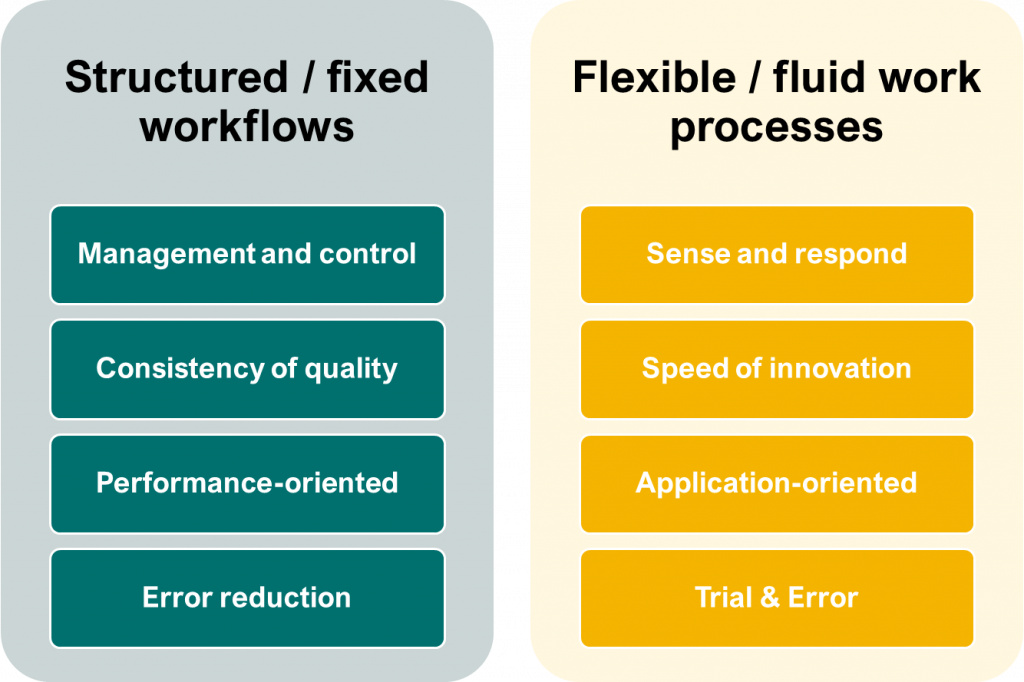
Both approaches are valid. But without clear communication and mutual understanding, friction is almost inevitable and collaboration can quickly stall
The Way Forward: Intercultural Competence and Openness
Successful cooperation across cultures does not mean one side adapting to the other. It requires intercultural competence: the willingness to question one’s own assumptions, recognize differences, and tolerate ambiguity.
Intercultural competence does not aim to eliminate differences. It enables organizations and individuals to use differences productively and develop workable forms of collaboration.
I exploreintercultural competence as a key professional skill in a separate blog article.
For acute intercultural challenges, I also outline a practical five-step approach to navigating difficult situations.