
Have you ever experienced a situation where different ways of working or different assumptions led to misunderstandings, frustration, or even conflict? And how did you deal with it?
In culturally diverse teams and international collaborations, situations like these are among the most common causes of friction. In some cases, they can even lead to projects stalling or failing altogether.
But it doesn’t have to be that way.
The problem is often not a lack of professional competence. More often, what’s missing is a structured way to deal with culturally shaped tensions.
In a previous article, I described why intercultural competence is a key professional skill and why simple lists of do’s and don’ts rarely provide a reliable solution. Yet when challenges arise in real projects, the practical question quickly follows: What should I actually do when an intercultural issue emerges?
The desire for clear guidance is understandable. Especially under pressure, people look for concrete steps to regain orientation.
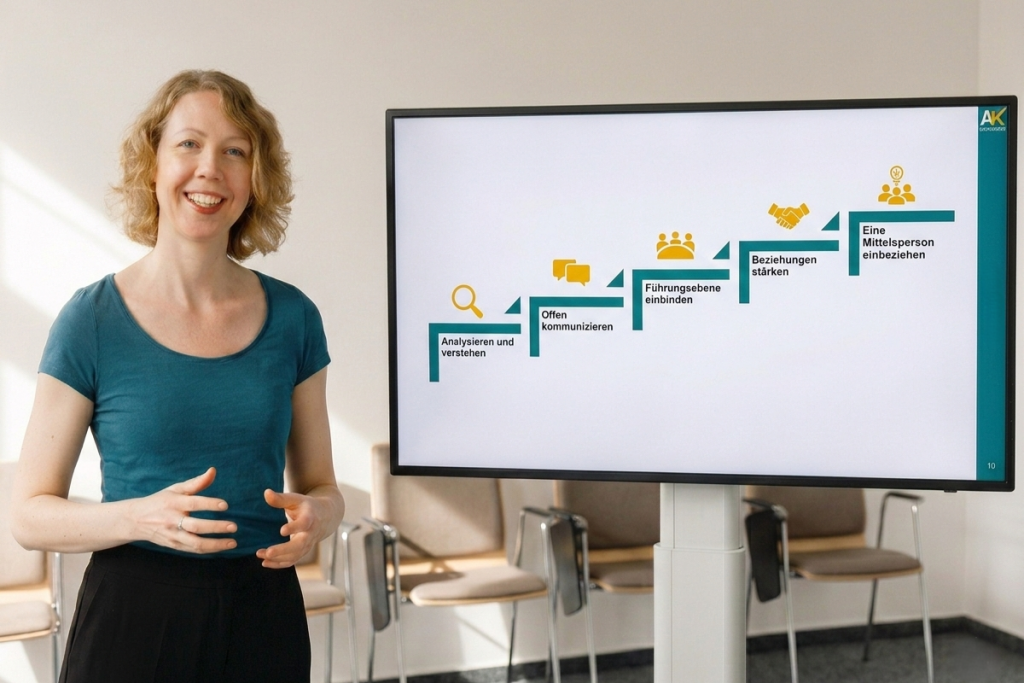
This is why I developed a five-step approach to managing acute intercultural challenges. It is not a rigid rulebook, but rather a structured way of thinking about difficult situations. The framework can serve as a personal guide for individuals or as an orientation model for organizations.
One important point: the framework does not replace contextual analysis. Every situation is embedded in specific organizational, cultural, and interpersonal dynamics. Not every step will be relevant in every case, and the order may vary. The starting point should always be a careful assessment of the actors involved, their cultural backgrounds, and the structural environment.
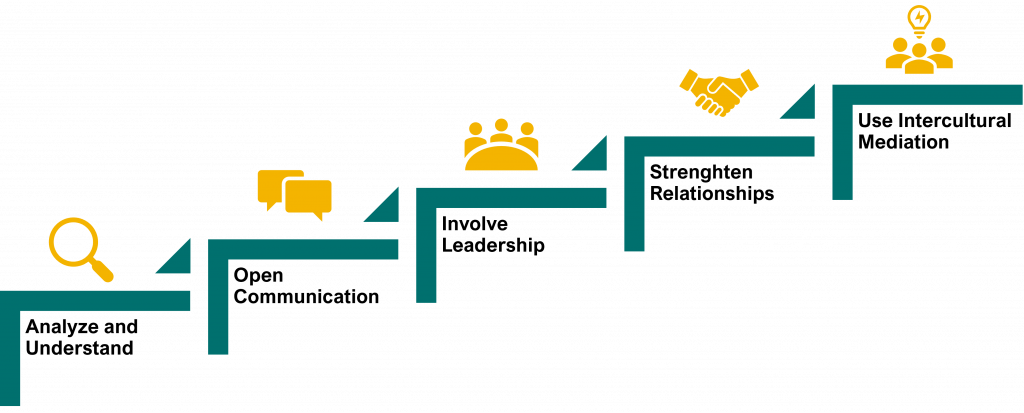
Step 1 – Analyze and Understand the Situation
The first step begins with reflection and analysis. When a challenge arises, the person experiencing it should first consider whether the situation stems from individual behavior, structural issues, or a potential intercultural misunderstanding.
This requires at least a basic level of intercultural awareness and an understanding of the cultural contexts involved. If this knowledge is not yet available, it can be helpful to involve external expertise. Training or consulting can help analyze the situation more systematically and identify cultural factors that may influence behavior.
Various analytical tools can support this stage. They help make culturally shaped communication patterns or work practices visible and allow people to better understand the perspective of the other side. The goal is to avoid premature judgments and explore whether cultural differences might be influencing the situation.
Step 2 – Address Misunderstandings Through Open Communication
Once the situation has been reassessed, the next step is open communication.
It can be helpful to share observations transparently and ask questions to clarify assumptions. The goal is to explore whether different expectations or cultural influences are shaping the situation.
Cultural differences should not be treated as a taboo topic. On the contrary, discussing them openly can strengthen mutual understanding and improve collaboration.
However, this conversation must take place on equal footing. Neither side should appear morally superior or claim to be “right.” Cultural differences rarely involve right or wrong. What matters is recognizing differences without judging them and finding practical ways to work with them.
Often, such conversations already help to de-escalate the situation.
Step 3 – Involve Leadership and Create Structural Solutions
If open communication within the team is not enough, or if structural changes are needed, the next step is to involve the next level of leadership.
Managers can help clarify expectations, adjust processes, and support organizational changes. It is important that both sides involve their respective decision-makers so that hierarchical structures are respected and alignment can be achieved.
This step helps institutionalize the insights gained. Intercultural challenges are then addressed not only at the individual level, but also structurally.
Step 4 – Build Trust and Strengthen Relationships
In international teams that collaborate mostly remotely, communication often focuses only on tasks and technical matters. Personal relationships develop slowly or sometimes not at all.
As a result, misunderstandings and cultural differences may remain unnoticed until they escalate.
Building trust and informal communication channels can make a significant difference. A personal relationship with key counterparts makes it easier to clarify misunderstandings quickly and maintain constructive collaboration.
This step is particularly important in cultures where relationships play a central role. But even in more task-focused cultures, trust makes cooperation far easier.
The way relationships are built depends on the context. When in-person meetings are not possible, alternative formats can help: informal online conversations, virtual coffee breaks, or additional communication channels.
Step 5 – Use Intercultural Mediation
In many intercultural situations, it can be helpful to involve a neutral intermediary. Ideally, this person understands both cultural perspectives and can help translate between them.
Such a mediator can take on different roles. They may provide advisory support, helping both sides better understand cultural dynamics. Or they may actively participate in communication processes and facilitate dialogue between the parties.
In some cases, involving such a role from the beginning can even be beneficial. When teams are inexperienced in cross-cultural collaboration, this support can prevent misunderstandings from escalating and help turn cultural differences into a strength.
The role of mediator can be external or developed internally within the organization.