
International cooperation has become the norm rather than the exception. Hybrid teams, remote work, global value chains, and internationally mobile professionals shape everyday work in many organizations. People from different cultural backgrounds collaborate more closely than ever before.
Such intercultural collaboration is not automatically characterized by mutual understanding. On the contrary, when the focus lies solely on professional expertise and cultural factors are not taken into account, misunderstandings, friction, and conflict often emerge. Intercultural collaboration happens when the familiar meets what is unfamiliar and both enter into a relationship with each other. This can be experienced as enriching and stimulating – or as unsettling and threatening.
To navigate such situations appropriately and to shape cooperation constructively, intercultural competence is essential.
Why Do’s and Don’ts or Cultural Etiquette Guides Are Not the Solution
In my work with organizations and in intercultural trainings, I am regularly asked for lists of do’s and don’ts. What people are looking for are clear behavioral rules, often found in cultural etiquette guides: How do you greet properly? How should business cards be exchanged? What is the appropriate business dining etiquette? What dress code applies?
Such rule-based knowledge can provide short-term orientation. However, it rarely determines the success or failure of international cooperation. In fact, do’s and don’ts can be misleading. They are often based on simplifications and stereotypes and create a false sense of security. Relying on supposedly “correct” behavior can lead directly into delicate situations, especially when the rules do not fit the specific context.
The reality of international collaboration is complex. Situations are dynamic, individuals are diverse, and contexts constantly change. Those who approach cooperation with intercultural sensitivity, communicate openly, and reflect on their own assumptions rarely fail because of etiquette issues. Those who merely memorize rules without developing a deeper understanding of cultural dynamics will encounter limits despite thorough preparation.
The key question is therefore not: Which rules apply?
But rather: What does intercultural competence actually mean?
What Intercultural Competence Really Means
A person is interculturally competent if they are able to recognize, reflect on, and respond constructively to culturally shaped patterns of perception, thinking, feeling, and acting, both in themselves and in others. This is not about adapting to “the other culture” or imitating behavior. The starting point is always self-reflection: the ability to identify one’s own assumptions, tolerate uncertainty, and resist the urge to resolve ambiguity too quickly.
There are many definitions and models of intercultural competence. One widely used and practical approach was developed by Darla Deardorff. Drawing on international expert perspectives, she conceptualized intercultural competence as the interaction of several dimensions, visualized in a pyramid model:
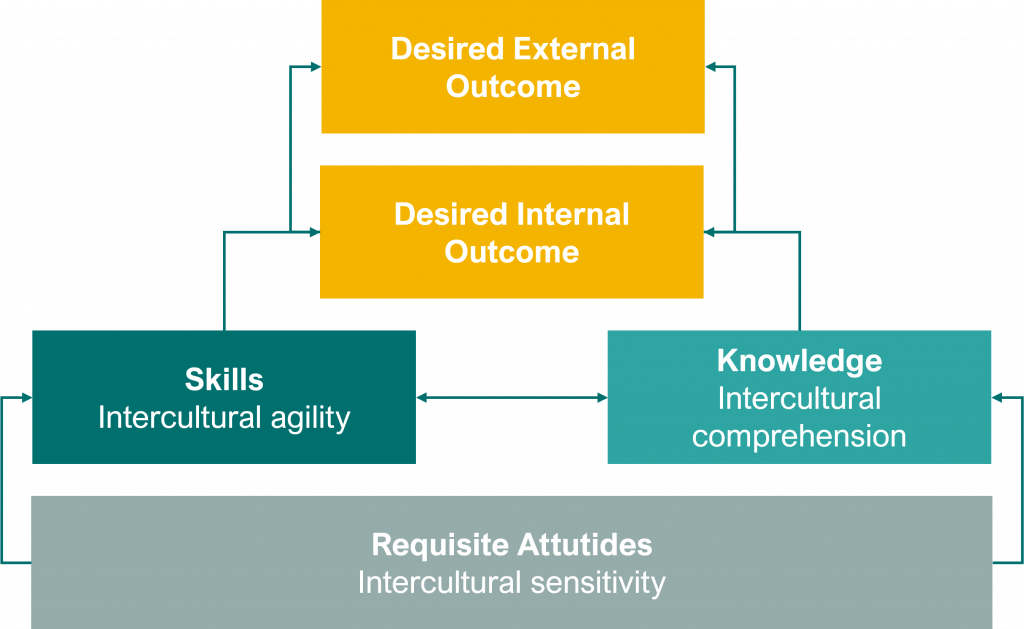
Pyramid Model of Intercultural Competence (Deardorff, 2006)
Attitudes as the Foundation of Intercultural Competence
At the base of intercultural competence lie fundamental attitudes. Without them, sustainable competence cannot develop. These include respect for cultural diversity, openness to other perspectives, curiosity, and the willingness to tolerate uncertainty without premature judgment.
This mindset is reflected, among other things, in:
- the willingness to question one’s own taken-for-granted assumptions
- the acceptance that irritation is normal and often productive
- the ability to separate observation from evaluation
If this foundation is missing, knowledge and methods alone are insufficient.
Knowledge and Skills: Orientation Instead of Recipes
Building on this foundation, intercultural competence requires knowledge about cultural contexts as well as skills to deal with differences constructively. Various tools can offer orientation:
- Models such as the Culture Map by Erin Meyer make differences in communication styles, approaches to hierarchy, or perceptions of time visible.
- In addition, knowledge of history, philosophy, and broader societal developments within a cultural context helps to make sense of cultural imprints and to practice a change of perspective.
- Exchange with experienced experts can further highlight recurring patterns and typical areas of tension.
Such knowledge can serve as a map but it is not a navigation system. Without the ability to interpret and apply it situationally, it can easily be misleading. Context always matters: the organization, the industry, the project phase, and the individuals involved.
Equally important are communicative and reflective skills, including:
- active listening and careful observation
- asking questions instead of jumping to interpretations
- change of perspective and “translation” between different viewpoints
- constructive handling of misunderstandings and tensions
- adapting communication without giving up one’s own position
Only through these skills does knowledge become actionable competence.
Achieving the Desired Outcome: Intercultural Competence in Action
From attitudes, knowledge, and skills emerges what is often referred to as the internal outcome of intercultural competence: the ability to respond flexibly to different cultural contexts, to develop empathy, and to relativize one’s own perspective. This ethnorelative worldview makes it possible to see differences not as deficits, but as part of the situation.
On this basis, the external outcome becomes possible: acting and communicating effectively and appropriately in complex intercultural situations. Communication becomes clearer, decisions more connectable, and cooperation more resilient.
Intercultural Competence as a Learning Process
Intercultural competence is not a static state and not a checklist. It develops continuously. Each new intercultural context requires us to go through this process again. Especially in challenging situations, it is worth pausing and asking:
- What assumptions am I bringing into this situation?
- Do I have sufficient contextual knowledge?
- Am I able to act effectively under these conditions?
Where gaps become visible, they can be addressed through learning, reflection, and targeted support. Experience, feedback, and also mistakes play a central role. Sparring partners, training formats, or coaching can support this learning process in a structured way.
What This Means for International Cooperation in Practice
Intercultural competence has a direct impact on everyday collaboration:
- expectations are clarified more explicitly
- escalation and friction are reduced
- the ability to act increases even in complex situations
- relationships become more sustainable rather than merely functional
International cooperation does not become conflict-free but it becomes significantly more robust.
Do’s and don’ts may be a starting point, but they are no substitute for intercultural competence. What matters is the ability to perceive differences, make sense of them, and use them constructively. Intercultural competence is therefore not an additional qualification, but a strategic key skill for international collaboration.
In my previous article on ways of thinking and working in German–Chinese cooperation, I showed how cultural imprints shape everyday work in concrete ways. In upcoming articles, I will take a closer look at practical cases and at how to deal with acute intercultural challenges.